(Established 2009) This is the history of our Year 7 and 8 classes in Huia 1 at The Gardens School, NZ. We wrote for ourselves, our families and friends and for anyone who wanted to know what life was like at our school. From 2009 to 2013, Huia 1's teacher was Mrs Vincent. 1n 2014, classes changed and Huia 1 became Miss Murphy's room, with Mrs Vincent teaching on Thursday afternoons in Term 1. This blog has now ceased regular publication but is a record of our time together in Huia 1.
A couple of weeks ago Brittany, Nikeeta and So Yeon started to make a video called 'Huia 1 Gumboot Movie' which is a comedy movie. Take a look at it above:
Be sure to vote how the movie was on our Huia 1 poll.
Check out our previous post to discover why we decided to make a movie about gumboots.
NEWS FLASH! The Reviews are Pouring in: Re: Gumboots - you've read the explanations - now see the movie Well done Huia 1. I really enjoyed watching your gumboot movie, it was so funny- I’m not sure if you intended it to be funny but it was. I was actually laughing so loud that a few parents came to my classroom door to see what I was laughing at. (Mrs C)
Re: Gumboots - you've read the explanations - now see the movieWow – what talent!
Can’t wait to show the class on Monday. (Mrs W)
That was great, my kids loved it and sang along with the song....the kids wanted to watch it again, so we played it and the parents waiting outside saw it and loved it too. Well done your class!! (Mrs G) Re: Gumboots - you've read the explanations - now see the movieFabulous!!! (Mrs M)
Our whole school is practising writing explanations and learning about the features that make a piece of information an explanation rather than, for example, a recount.
In Huia 1 we are going to write an explanation about "Gumboots". Many of the students in Huia 1 had never worn gumboots before and, in the best interests of authentic learning experiences, we carried out first-hand (first-foot?) research by wearing gumboots and splashing around in a mud puddle which made a timely appearance after a particularly heavy downpour of rain.
Thanks to Mrs Dillon and Mrs McCarty for the loan of your gumboots. We will try to get them back to you as clean as they were when we first borrowed them... but we DID learn that gumboots are specifically designed to get dirty, and tested this rigorously.
Disclaimer: No child suffered in the making of these images.
We had fun learning about the importance of gumboots in rural New Zealand. Check out here for Fred Dagg's Gumboot song. We have watched this video many times to research what it is about gumboots that makes them so special. Most of the class are now singing along with the chorus.
Mrs Dillon, from Kiwi 3, visited Huia 1 (to check out if we were looking after her gumboots?) and told us about her experiences wearing gumboots in Iceland, where she worked as an inspector in a fish factory some years ago. We learned that, in Iceland, gumboots have a wedge in their sole to help prevent the wearers slipping on ice.
Interesting things we have learned in the process of our gumboots research...
1. We learned how to pronounce theIcelandic volcano (Thank-you for the Icelandic language lesson, Mrs Dillon.)
5. A gumboot dancewas developed by miners in South Africa as a means of communicating with each other in darkness underground and as a way of coping with their extremely hard conditions. Check out one of the many You Tube videos of gumboot dancing here.
6. We learned a whole lot of new words from the background reading and research we did on gumboots:
Check out Spelling City here to test yourself on these words and to play games and activities to help you learn and understand the meanings of these words. Please note that the pronunciation is very American (is is a USA site, afterall) and that vulcanisation and abattoir are not yet in the SpellingCity dictionary. We feel very clever that we know how to use these words...and millions of Americans (and people all around the world using this site) don't.
This is a fast-frame record of some of our gumboot experiences. Click on the pause button if you want to see any image for longer.
Here are some photos from our choir's participation in the World Vision Kids for Kids "Top of the World" Concert with Suzanne Prentice, last Wednesday at the Telstra Clear Manukau Events Centre. Here are some photos from the rehearsal, earlier in the day.
Can you find us in our school uniforms?
Nicole auditioned, and was chosen for one of the soloist parts in the show.
Late that evening...
Some of the choir members, back stage.
Choir boys...
Cna you find our choir members?
The Gardens School Choir
Check out here to view an interview with Suzanne Prentice in Rotorua (last year) talking about the Kids for Kids Concerts .
On Tuesday some of our Huia 1 students went to do tree-planting in Totara Park for Arbor day which is an event when people get encouraged to do tree-planting. Here are two people we interviewed about their tree-planting experience (Kumiko and Sambit).
1.) Why do you think tree-planting is important for the environment? Answer (Sambit): It gives us oxygen.
Answer (Kumiko): It makes us a tidy Kiwi.
2.) What did you enjoy the most, out of the whole experience? Answer (Sambit): Planting the trees.
Answer (Kumiko): Facing my fears by touching a worm.
3.) What do you think made this whole event enjoyable? Answer (Sambit): Planting the trees.
Answer (Kumiko): Getting involved with different people and trying out different things.
Here are some of the pictures:
Above : So Yeon & Kumiko
Thanks you Mrs Whitehead (Kea 1) for organising this day for us.
Our classroom wall showing some of our Spanish words used as a border, some of the photography work we have done in Poutama and some photos from camp.
Last week we had started school on Tuesday because it was the Queen's Birthday. On Tuesday we had Mrs Lee for the day because Mrs Vincent was on a course. We did some Spanish art , spelling and maths. Mrs Vincent's maths class did maths in Spanish with Mrs Lee.
We made a border for the wall using words and phrases in Spanish.
On Wednesday Mrs Vincent was back and we had only a half day because of parent teacher interviews...but we still did spelling, maths and we learned some spelling rules. Here are the spelling words that we learned last week:
We also learned some tips and tricks to help us remember the spelling words. Here are a few:
- pro - nun - ci - ation - question - n - air - e (2 ns in questionnaire because there is always more than one question) - pro - dig - iou - s ( these 'gi' letters have a soft /g/ sound as in giraffe and digital
- quotient and partial both have 'ti' letters which make the sound /sh/ - quagmire, quaff and quarantine all have the letter 'a' making the /o/ sound as in hot.
We learned to break the words up in different ways to help us spell them easily. (We don't always use syllables to break words into easy chunks to learn.)
Try spelling those out for yourself or you can try take a test by simply going on spellingcity.com.
Last Thursday we went on class trip to Telstra Clear Events Centre for Dancing with Mythology activities. We were joined by students from several other schools and we learned about Maori history and the legends. We also had activities to do like singing, performing, dancing and drama. Everyone got to perform one item on stage. We all had a great time and the trip at the Events Centre.
On Tuesday we had a special guest to our school . Her name was Jaslyn and it was her first time in New Zealand. She is a teacher from Malaysia and she is visiting New Zealand schools in her own school holiday time with the AFS organisation.
Here are some of the Question we asked Jaslyn :
1) What was your first impression when coming to New Zealand? A) Happy and confident
2) How do you like our school so far?
A) It's OK - it's my first school in New Zealand so I am undecided.
3) Was it quite hard to talk in English when you learned it? A) No - I was confident
4) Do you like NZ so far? A) Yes
5) What job do you do in Malaysia ? A) I am a teacher.
6)What do you think is different to NZ schools and Malaysian schools? A) A huge difference
7) What time do students start arriving at school in Malaysia? A) 7.15 AM they start arriving School starts at 7.30 - 2.40pm Pre-school starts at 7.30 - 1.30 The sport time is 3.00pm - 5.00pm
8) What do you think about New Zealand weather ? A) The weather is quite calm compared to Malaysia.
9) Does your school/teacher give harsh punishments to the students ? A) The cane and duck squats .
Jaslyn with members of Huia 1 and Mrs Lee, our Spanish and Music teacher, who was working in our room at the time of Jaslyn's visit.
We hope you have a lovely time in New Zealand. By Brittany and Nikeeta
This week we have been getting back into our routine and catching up on some work.
It has been two weeks since we have been back from camp. Camp was awesome. We all enjoyed it and loved our great experience and are catching up on some work - like recounts, "Inside Me" poems, explanation writing and getting back into our SSR (Sustained Silent Reading).
Here is some of the students' explanation writing on hobo stoves:
Explanation Writing - Hobo Stoves
A hobo stove is a fun and easy way to cook and prepare simple meals.
A hobo stove is a tin stove which is roughly a 17-18 cm long stove and the little tin is 8 cm long.The little tin has some wax and spiral shaped cardboard so you can light it. The little tin is actually a condensed milk or baked bean tin, and they work perfectly!The bigger tin is for cooking similar to a fry pan. You can cook almost anything on it - for instance sausages, pikelets or pancakes etc.
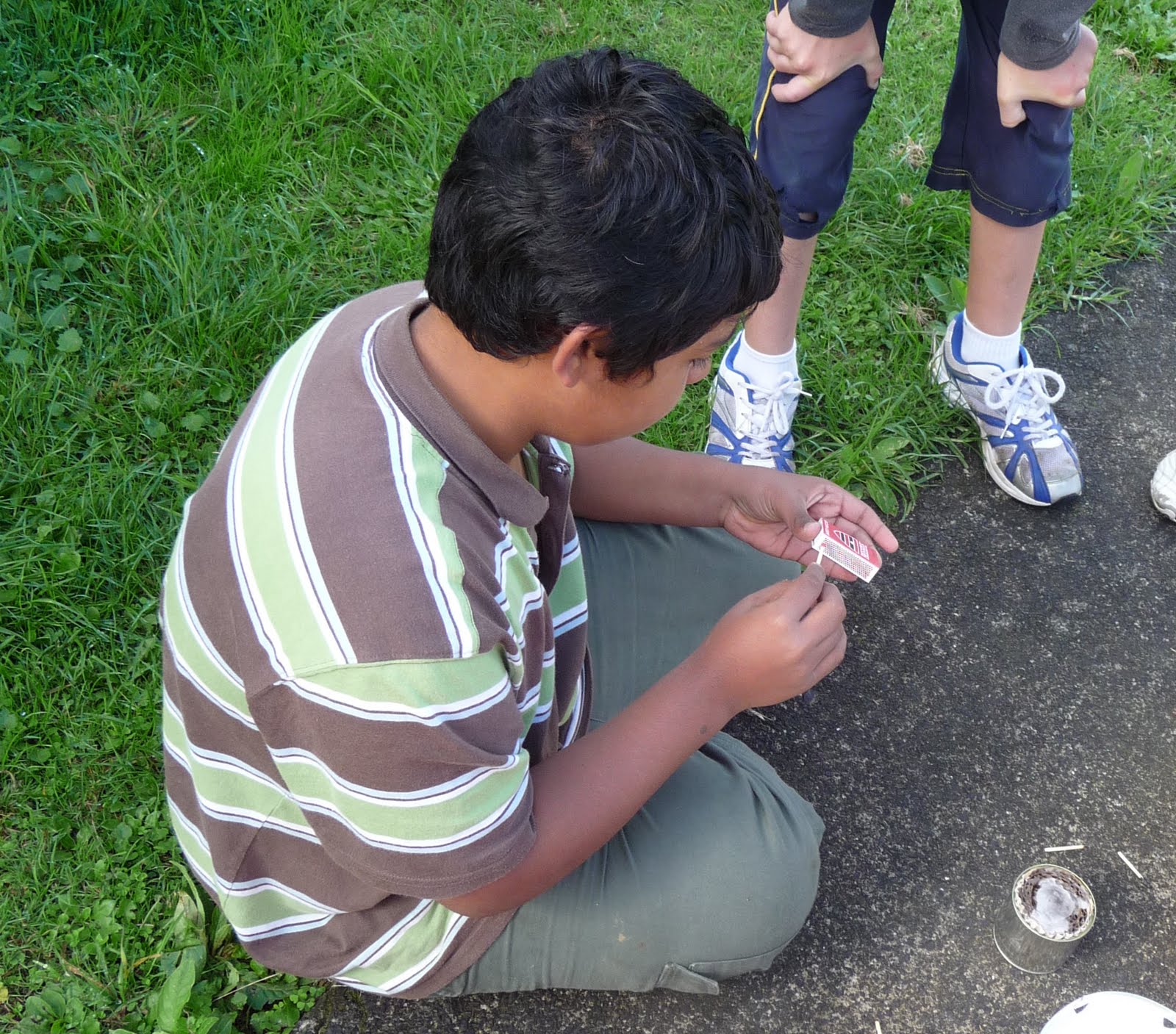
When you want to cook or start cooking on a hobo stove, you first light up the small tin. Once it has been lit, you cover the bigger tin over the smaller tin which makes it all hot when you leave it for approximately 2-3 minutes.Once it is heated, you can add a little bit of olive oil and once you have poured the oil you can start cooking - which is a lot of fun!
When you have finished cooking, you can carefully remove the bigger tin and blow out the smaller tin. Leave it for a while to cool and once it has cooled down you can wash it.
Nikeeta 25 May 2010
2.
A hobo stove is used for outside cooking. It is great for camps.
A hobo stove has two units. There is the outside unit and it has to be 17.5 cm or bigger. It has holes around the top and bottom. The top hole lets smoke and carbon dioxide out and the bottom lets air come in. The second unit is a small can about as big as 8.5cm. This can is used for the flame. It has card board and wax in it.
You first light a match and place it on the card board and wait for a flame then put the big can on top.
When you have finished put the big can over the small one and the flame will be gone.
But I think no one under about 10 or 11 should use the hobo stove without a parent or guardian with them. But over all, hobo stoves are fun to use.Nikhil 25 May 2010
3.
A hobo stove is something that you use to cook on. Hobo stoves are made from a large steel tin and a small steel tin filled with corrugated cardboard covered in wax.
When you light a hobo stove with a match, it is the small tin with corrugated cardboard and wax in it that you light. Then you put the large tin on top to let oxygen get in and out of it.
When you start to cook anything you need to oil the cooking surface. On a hobo stove you can cook pancakes, fruit, sausages and toast in sandwiches in tin foil when it has heated up.
When you have finished using the hobo stove, lift up the bottom of the hobo stove and turn it so the part that you were cooking is facing the ground. Then put it on top of the little tin. Leave it for a little while to cool down. Wash it when it has cooled down.
Hobo stoves are fun to cook on.
Brittany
25 May 2010
A few groups of students had a competition to create a camp alphabet in less than 5 minutes. Here are the combined results:
Awhitu Alphabet
A - Awhitu, awesome, apple crumble, aqua shoes
B - Bolivia, burgers, ball, bed, beach
C - Cabins, cans, crabs, camp, cliffs
D - Dads, dinner, dirty, dishes
E - Electric fence, eels, ensalada, espanolF- Fun, friendship, fences, fishing
G - Grounds, grass, girls versus guys games
H - Hose, hobo stoves, helado,
I - Ice-cream, idiots, intense, I made new friends
J - Jelly, jogging, jueves, juice
K - Kids, kauri tree, kind parents
L - Lighthouse, la comida, lentils, lookout
M - Mexico, mud, museum, marshmallow
N - Native, nature, nobody left out
O - Orpheus, orienteering, our times have been fun
P - Posts, pohutukawa, pies, pikelets
Q - Queues, quail,
R - Road, rimu, rocks, rescuing sausages
S - Sunset, sunrise, sea, soccer
T - Tide, tins, toilets, towels, trees
U - Undies, ukulele, urinal,
V - Venezuela, vegetarian, verandah
W - Walking, wind, wet, water
X- Extreme, extraordinary
Y- You're always having fun
In our team we are learning to write a recount which is a non-fiction account of an event or something which has happened. First we looked at what the features of a recount were. Then we practised writing a few sentences to make a short recount and after that we wrote this together as a class- with much discussion and many additions and alterations as we went.
On a cloudy, dull-weathered Wednesday morning we arrived enthusiastically at the historic Manukau Heads lighthouse, about 20 minutes by bus from our camp at Matakawau on the AwhituPeninsula. We were excited because we wanted to see where the Orpheus shipwreck happened, since we had learned about it in class.
We were met by Paul Dixon and Sue Johns and their dog, Toru - our tour guides. Toru was wearing a lighthouse jacket with a cross-stitch picture of the lighthouse on it.
First we climbed a flight of steps (about 119 of them) up a steep hill to reach the lighthouse and the lookout where we sat and listened to a talk by Paul who told us about the history of the original lighthouse which was first built after the Orpheus shipwreck in February 1863.
Paul also told us that the original lighthouse was across the valley. He explained that a group of locals organised refurbishing it and making it an exact replica of the original lighthouse. He told us about the wood carving nearby which was done by a man in memory of his mother and wife.
We learned that the Manukau peninsula is made of sand and across the harbour is made of volcanic rock. Paul showed us a piece of metal which had come from a shipwreck in the harbour and had been discovered on the beach.
Paul asked us, "Who can guess how Toru got his name?" Rosie guessed it was because the dog had three patches on his back. Toru means 'three' in Maori.
Then we split into groups to explore the lighthouse, to go to the lookout and to have a quiz with the teachers and parents.
In the lighthouse we learned about the light and the prisms and that they are now obsolete. "It is one of a kind," said Paul about the light.He values the prisms as diamonds. "If you cut your finger on one, it would really hurt," he added.
The original lighthouse used paraffin for the light and needed two men to keep it going in six hour shifts. We learned that you could not live in the lighthouse because it leaked. From the deck we could see the exact point where the Orpheus sank on the sand bar. We could see hugely strong currents in the water and a small boat struggling through the waves which were bigger than they looked from our position. We could also see where the old signal point used to be and where the Tasman Sea meets the ManukauHarbour. In the distance we could see Auckland city and the Skytower.
It was a peaceful and calm place because it was so quiet.
At the lookout we learned more about the Orpheus shipwreck which happened at 2 oclock on a sunny afternoon in good weather and quite close to land. It sank because it hit the sand bar in shallow water. Many people on board could not swim and 189 lives were lost. It is New Zealand's greatest maritime disaster.
At the end of our visit, we thanked Paul, Sue and Toru and got back on the bus to go to the OruaBayBirdPark. We had learned a lot that day and many of us decided that we would like to return with our families so we can show them what we had experienced.
Here is an article about our visit, published in the Waiuku Post.


.JPG)