Showing posts with label Butterflies and Caterpillars. Show all posts

Wednesday, November 13, 2013

Garden Update - more than just an overgrown patch of plants.

 
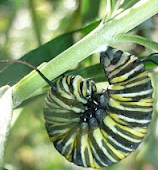
This caterpillar is about to turn into a chrysalis. Can you see how the caterpillar attaches itself to the leaf? Can you tell which end of the caterpillar is which? 

Here is a better view of the caterpillar attaching itself to a leaf.
I wonder what this little insect is?
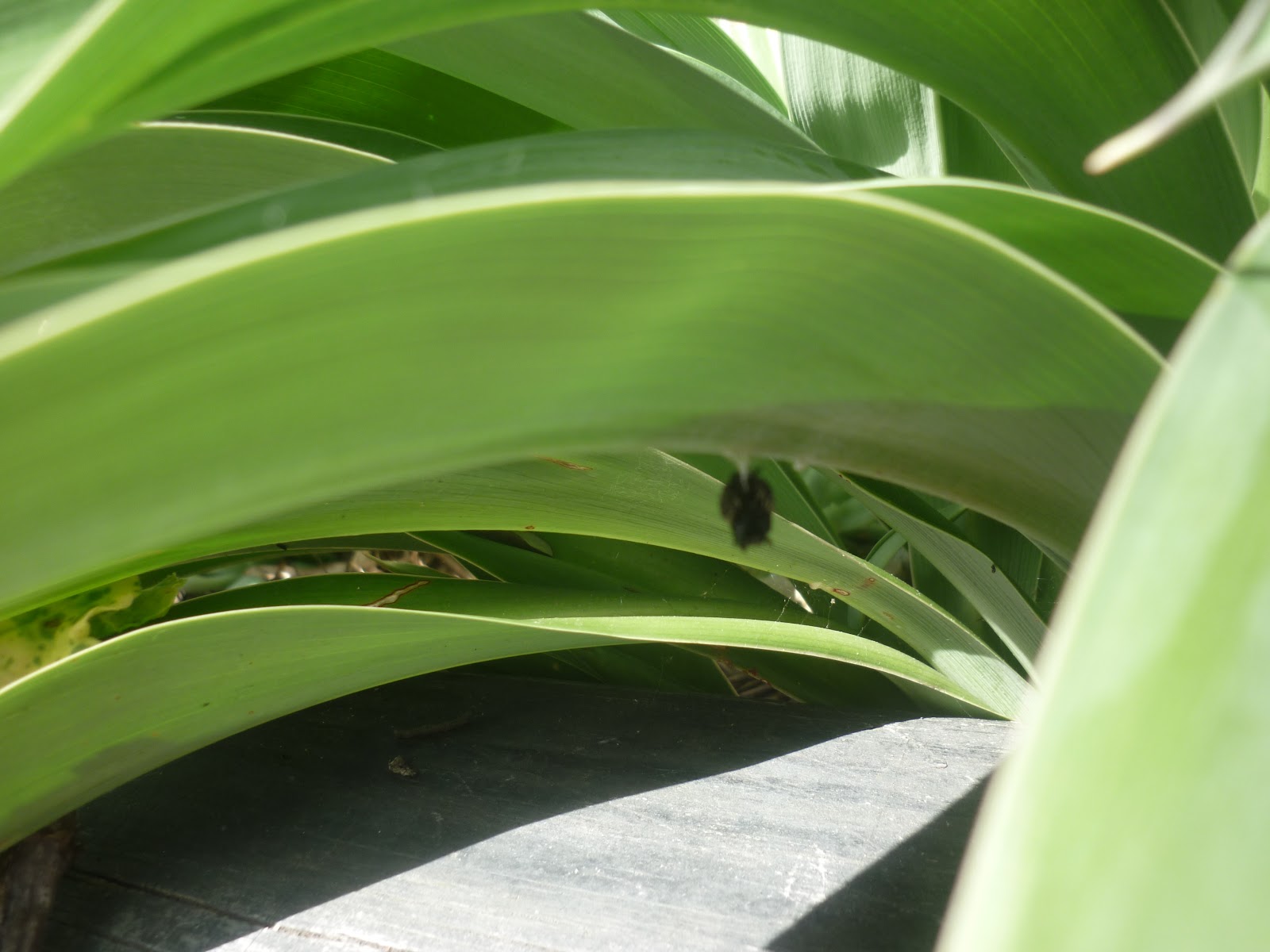
This caterpillar wanted some peace and quiet and moved to underneath a geranium leaf to make its chrysalis.


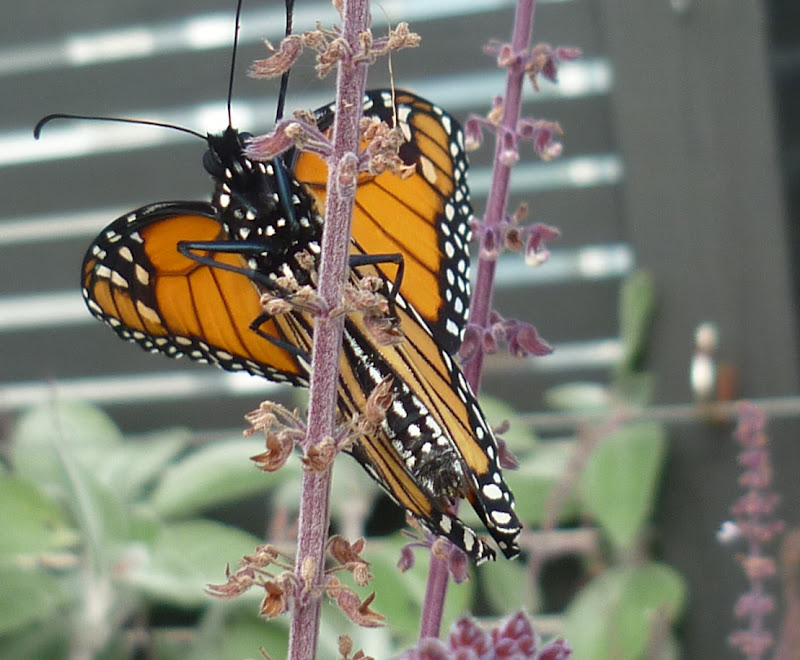
Our first butterfly of the season?

This caterpillar moved off the swan plant and onto a succulent plant.

How many caterpillars can you count?

I wonder where this caterpillar is headed off to? I think it might get very hot feet after a while.

A wasp visits one of our garden plants.

A caterpillar has also moved onto this plant. Can you see a bee, too?

There is a bird here who does not want to be seen. We love having her in our garden, but it's probably not the smartest pace to build a nest.


We wonder what kind of bird lays eggs like these.


Wednesday, April 10, 2013

Lost and Found: What's living in our garden?

 Here's a link to Kereru 1's  video about bullying. It has some powerful messages.


Read the latest school newsletter; you never know when Mrs Fowler will ask us a question about it at assembly.
Our swan plant was looking pretty sick. Over Easter, the three caterpillars disappeared. We thought they weren't old enough to make a chrysalis, and wondered if someone  had taken, or harmed them.
But this week, three caterpillars appeared on another healthier swan plant at the other end of the garden. We wondered if someone had transferred them. There does not appear to be any other monarch caterpillars around our garden this year. 
The aphids - and lady birds are back.


You can almost see the bee's knees . . .


Another caterpillar in our garden. This is not a monarch caterpillar. Is it helpful or  harmful? What kind of butterfly or moth will it change into?


We enjoyed reading about  Mrs Whitehead's pigeon (kerereu) rescue. You can find out more about it here.   We are looking forward to hearing about its progress.

On Sunday, Karmveer and Corbin are representing us at the Sunrise Walk to help raise funds for the local hospice. The class have brought donations to help support our two boys and the cause.

Our Rugby Picks for the Weekend:
(Winning team and winning margins written first)
Brumbies 13+ against Highlanders Picked the winner but not the right margin
Chiefs 1 - 12 against Reds
Blues 1 - 12 against Hurricanes
Rebels 1 12 against Kings
Crusaders 13+ against Force
Sharks 1- 12 against Stormers
Cheetahs 1-12 against Bulls

Tuesday, March 26, 2013

Look Who's Back in our Garden ...


How many caterpillars can you see?
Can you see the tiny aphids?

Photos by Alisha

Sunday, August 12, 2012

Haiku Poems 2

After writing group and class haiku poems, each student had to write a haiku independently. We used our class garden for inspiration. Some wrote a haiku  based on a photo of one of our monarch butterflies which hatched in our garden earlier this year, others looked elsewhere around the garden. We learned how to get maximum impact from only 17 syllables. We also learned how to hyphenate adjectives to help make our descriptions more precise. Here are some of the results:


Hanging by a thread
A butterfly clinging on
Not wanting to fall
Flynn 

Intelligent bug
White snow dots on flaming wings
Bring out the beauty
Hoani

Gentle and tranquil
Sweet exquisite-winged angel
Flap your wings and fly
DC

Spotty stripy heart
Pretty-patterned butterfly
Elegantly formed
 Jessica

A heart-shaped beauty
Exquisite appealing beast
Delicate round eyes
Tonu

Impressive flyer
Slim, hopeful, intelligent
Silent creature dies
Jackie

White-spotted outline
Exquisitely spreading wings
Slurping in nectar
Alisha


Delicate creature
Orange, black, white spots and stripes
Butterfly, roam free
Trent O’S

Heart-shaped butterfly
White-spotted wings fluttering
Landing on the leaf
Danny

Heart-shaped butterfly
White, black and orange wonder
Perch’d in the  garden.
 Cameron W


Gliding in the sky
Setting off to live its life 
Fluttering black wings
Glenton

Spotted, soaring, small
Mingling amongst leaves and twigs 
A glamorous sight 
Rudadiso 

Gentle orange wings
Crawling with insect-like legs 
Go and fly away
Bridget  
Clouds
Big, white fluffy clouds
Silky-soft cotton candy
Hydrated and stormy
 Kylah 
Flowers
Different colours
Lavender, daisy and rose
In gardens they grow
Kylah


Water
Fast current flowing
Puddle river waterfall
Worldwide hydrating

Renae


Sun
Yellow red burning 
Blazing bright big blinding sun
Gigantic shiny                         
                         
Ramandeep  
                                 

Wednesday, March 28, 2012

Visitors to our Garden


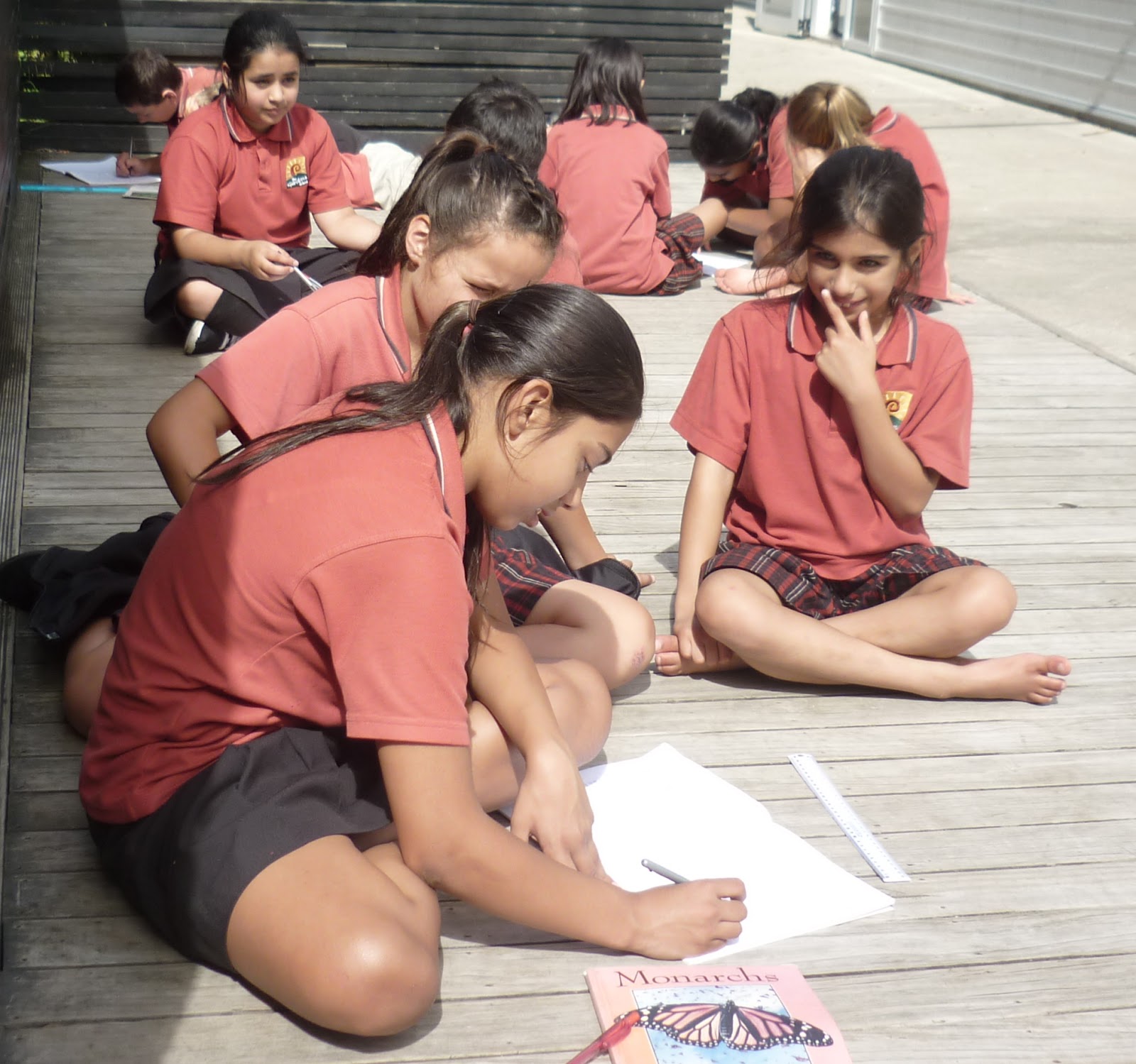
Today, instead of buddy reading, we did buddy writing  with Tui 1 (Year 4)  students after inviting them to look in our  garden.  Our class taught Tui 1 about caterpillars and butterflies. Here are some of the stories our class wrote with our buddies.

Our Story
We saw a chrysalis, and we saw one that had fallen down. We learned how to thread a fallen chrysalis and peg it to a container. They put a tissue so that if the chrysalis fell down it would land softly. 

We learned ways that a caterpillar could get a disease. We learned about how a chrysalis gets stuck to a branch or a leaf. We were allowed to bring two chrysalises and a caterpillar  back to Tui 1 with us. 


We learned that when a caterpillar is born it has to eat lots. We saw two baby caterpillars. We also saw a caterpillar trying to eat a stalk. 

We learned the cycle of a caterpillar turning into a butterfly. We learned to tell a male butterfly from a female butterfly. We also learned that pray mantises and paper wasps eat caterpillars.
Written by Jess, Maddi, and Hannah.


Some of the butterflies' and caterpillars' predators are praying mantises. First the praying mantis hunts its prey, then it makes sure it doesn’t escape.  Then it attacks it and then it eats it. Another predator of the caterpillars and butterflies  are the paper Wasps.  The wasps hunts the caterpillars down then it stings it to kill it and then it eats it.
Latrey 


Caterpillars are black, white and yellow and they can die easily. They turn into a chrysalis and then they turn into a butterfly.Then they lay eggs and then fly to a better place.Then they lay more. The monarch butterfly lays about 300 - 400 eggs in maximum*.The caterpillars eat lots and lots of leaves and then when they get older they turn into a chrysalis. Lots of people get mixed up with a male butterfly and a female butterfly. It is easy to tell because the male butterfly has dark spots on its back but the female butterfly doesn’t have these dark spots.The male butterfly does not lay eggs.
* to be researched further.
Jackie


Firstly the monarch butterfly starts out as a 1.2 mm size egg that another butterfly lays. After three or four days the egg hatches into a tiny little caterpillar. Once the caterpillar has been eating swan plant leaves for a week or so it is ready to turn into a chrysalis. First the caterpillar turns like an upside down spiral, then a green shade covers it up then it turns into a chrysalis, then it turns into a beautiful butterfly.
By Trent and Cameron 


 Things we have discovered this week: 

This is the egg case (ootheca) of a South African praying mantis.

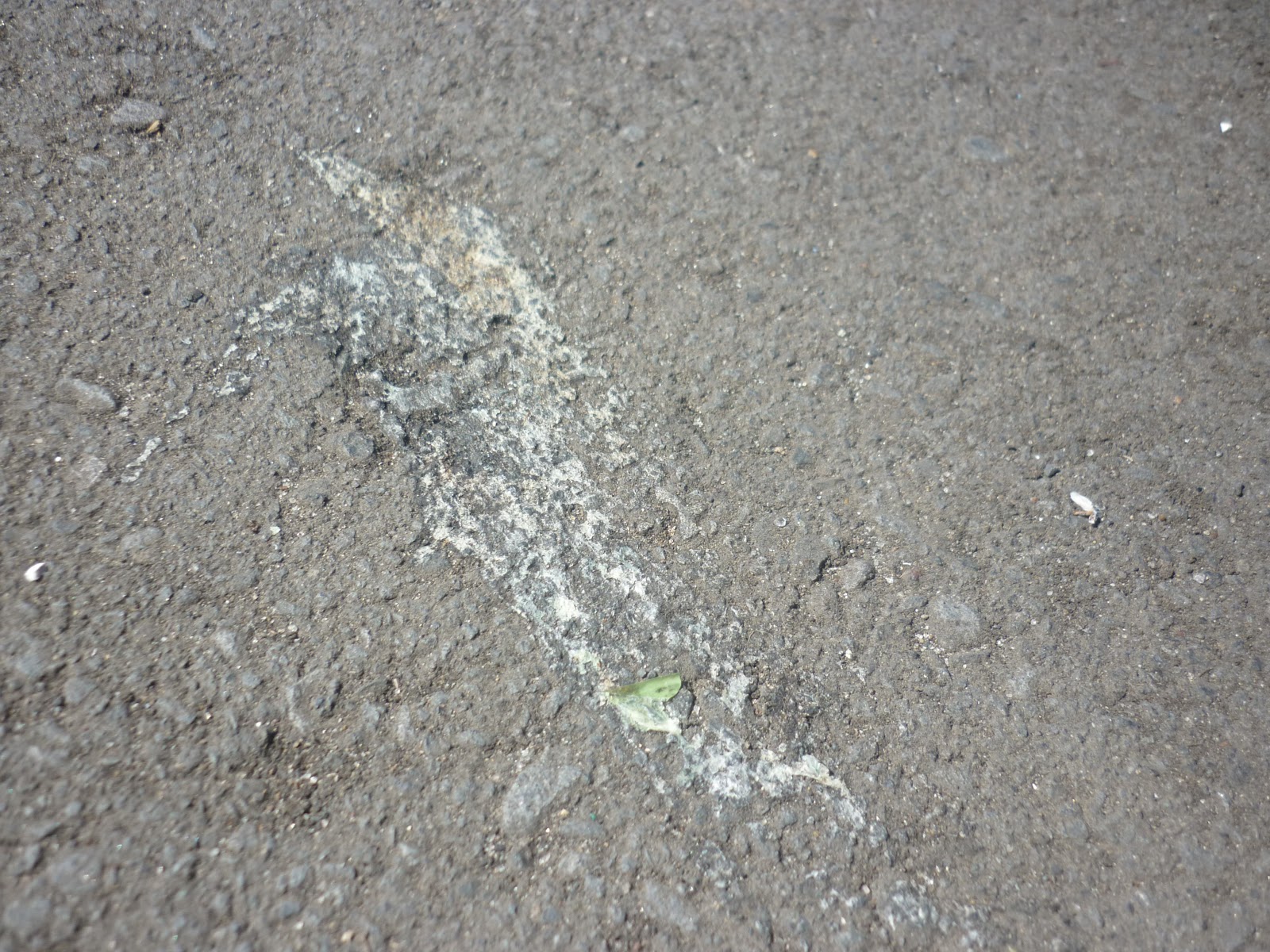
These are not the ootheca of South African (or any) praying mantises. They are, in fact, used  bubble gum left on a post in our garden.  Yuck! But, from a distance, it had us fooled for a while. We now know the difference.

Some caterpillars will die of disease.

Other recent visitors to our garden:


The bees are enjoying our garden

Aphids and ants on our busy Lizzy plants. Lady birds won't be too far away.


Another caterpillar to identify.


Can you see a green caterpillar on the swan plant? It's a cabbage butterfly caterpillar, after Mrs Hansen's class's newly planted cabbage plants, no doubt. We have seen a few white butterflies around the place.


We need to identify what kind of caterpillar this is. A student from another class found it and brought it to show us. 


Can you find the fly on the leaf?


Monday, March 26, 2012

Another Day, Another Disaster, Another Rescue

It seems our celebrity caterpillars may have become victims of their own publicity.


Apart from the natural dangers and predators our caterpillars encounter, they now have to contend with frequent and fascinated observers - not all of whom are able to keep their curiosity and fingers to themselves.


This morning (Monday), when we went to check on one of the chrysalises under a leaf overhanging the garden border - it wasn't there, and all that we could see was the remains of its last moult as it turned into its chrysalis. We knew it hadn't hatched as it had not been a chrysalis for long enough - and there was no empty case hanging.

This is the way the chrysalis looked last week. It's nowhere near ready to hatch.

This is the way the chrysalis looked on Monday morning. Note, there is no chrysalis case.
This appears to be the remains of our chrysalis, on the asphalt nearby. There is just the smallest remains of a green chrysalis case in the bottom centre of the photo. 


Can you find a chrysalis on the ground? 
This has been knocked off its branch. It is a perfectly healthy chrysalis and we found it on the ground in our garden.

We went to The Monarch Trust website FAQs tab  and followed the instructions for saving a fallen chrysalis. 

First, we carefully lifted it up with a piece of paper and brought it inside. 

Then we carefully tied a piece of thread around its cremaster
Photo below from Meandering Thoughts  blog.


And then we very carefully pegged it to a margarine container and placed it safely on the sink bench.

We have put a bit of tissue underneath it in case the chrysaslis falls.  


First position looked a little unsafe and we thought the chrysalis might get stressed if it got bumped.The container was resting against a surface but could easily fall over. 

Final solution: we shortened the thread so that the chrysalis was supported by the side of the container, and used a small peg to hold the thread in place. There is enough space for the butterfly to climb out and have something to perch on. 

Meanwhile, here's a progress report on some of our other chrysalises. Can you find three chrysalises in this photo?


This chrysalis is close to hatching.
 This chysalis still has some drips of water on it from overnight dew.


Saturday, March 24, 2012

Progress Report on Lauren's Caterpillar Refugees


Check out this website all about the
 monarch butterfly in New Zealand
It has lots of valuable information, interesting facts, and ideas about how to care for the monarch butterfly and caterpillars.


Lauren rescued some of our very hungry caterpillars and took them home to her caterpillar-less swan plant. They have obviously settled quickly and are busily eating their way through their new homes. 


Here are some photos Lauren took of her happily relocated caterpillars. 
This photo gives an excellent close-up of the caterpillar's 3 pairs of legs and its prolegs. Great photo, Lauren.


One of Lauren's caterpillars is ready to turn into a chrysalis.


Other good news:

- We were given three healthy leafy swan plants in pots by a parent from Mrs Scott's room. Danny, DC and Lauren planted these in Huia 2's half of our garden plot - which we now want to develop as a bit of a waste land - with butterfly-friendly plants. (Sorry, Mrs Fowler, but it's for a good cause.) 

- We have given away lots of caterpillars to people with  vacant  swan vacant plants at home.

- We found new seedlings of swan plants growing in Huia 2's half of the garden.

- Many of the fatter and larger caterpillars, which we thought were going to starve, have turned into chrysalises. 

- Our relocated caterpillars are making good progress.

Here are some photos of our caterpillar rescue and relocation: 
Lauren, DC and Danny found some space in Huia 2's half our our garden plot. They planted one of the donated swan plants there.


Some caterpillars had already found some self-sown swan plant seedlings. I wonder if this swan plant will ever get a chance to grow full size ...

This swan plant is planted a bit close to the olive tree- but the caterpillars will feel at home around all the chrysalis-like olives on the tree at the moment. We could only plant the swan plants in spaces we could reach without standing on any of the other caterpillar-bearing seedlings we found in this garden.

Lauren watering her newly planted swan plant.
Look very carefully and you can find three desperate caterpillars looking for food. They do not like to eat rosemary and settled very quickly into eating again when they were put on a swan plant.

Danny relocating the caterpillars - very carefully. We usually do it with a leaf but this little guy would not cling to it and curled up, so Danny did it very gently by hand. How many caterpillars can you count here. Do you think there will be enough food for them? What could we do?

We tend to talk to the caterpillars and encourage them to hang on carefully. It seems to be working.


Danny and DC take care not to tread on any caterpillars which we found crawling along the clover and ground level swan plant seedlings.

Ground level caterpillars. We had to be very careful not to stand on them.


I wonder where this little guy is going? Which end do you think is which?


Check out the previous blog to  find out what these two chrysalises looked like the day before.